


Blog
NEMA 14-50 vs NEMA 6-50: EV Charger Outlet Comparison Guide
Introduction
If you’re installing a Level 2 EV charger at home, one of the first decisions you’ll face is the outlet type. The two most common options are the NEMA 14-50 and the NEMA 6-50. Both are 240-volt outlets capable of delivering high power for fast home EV charging, but they differ in ways that matter for safety, cost, and long-term usability.
This guide cuts through the confusion. By the end, you’ll know exactly which outlet fits your EV charger, your electrical panel, and your home setup.
Who This Article Is For: Homeowners and renters installing a Level 2 EV charger who need to choose between a NEMA 14-50 and NEMA 6-50 outlet.
What Is a NEMA 14-50 Outlet?
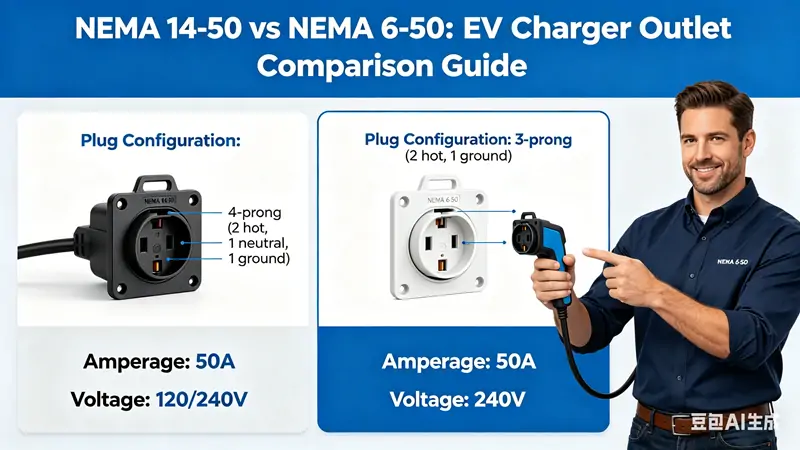
The NEMA 14-50 is a 50-amp, 125/250-volt, 4-prong outlet commonly found in RV parks and modern homes. It’s the de facto standard for high-power home EV charging in North America.
Key Specifications of the NEMA 14-50
| Specification | Detail |
|---|---|
| Voltage | 250V |
| Amperage | 50 amps |
| Prongs | 4 (two hot, one neutral, one ground) |
| Max Power | 9.6 kW (at 240V) |
| Common Use | RVs, electric stoves, EV chargers |
| Outlet Cost | $15–$40 |
Why the NEMA 14-50 Is the EV Charging Standard
Tesla ships the Mobile Connector with a NEMA 14-50 adapter as the default. Most aftermarket Level 2 chargers (ChargePoint, Grizzl-E, Emporia) also list the NEMA 14-50 as their primary plug-in option. That ubiquity matters—if you move to a new home or buy a new EV, the infrastructure is likely already there or easy to install.
The neutral prong means the NEMA 14-50 can supply both 120V and 240V circuits. While that’s largely irrelevant for EV charging, it adds flexibility for other appliances.
What Is a NEMA 6-50 Outlet?
The NEMA 6-50 is a 50-amp, 250-volt, 3-prong outlet. It looks nearly identical to the 14-50 but lacks the neutral prong.
Key Specifications of the NEMA 6-50
| Specification | Detail |
|---|---|
| Voltage | 250V |
| Amperage | 50 amps |
| Prongs | 3 (two hot, one ground; no neutral) |
| Max Power | 9.6 kW (at 240V) |
| Common Use | Welding equipment, air compressors, motor homes |
| Outlet Cost | $12–$35 |
Why Choose a NEMA 6-50?
The NEMA 6-50 is common in industrial and commercial settings, and some EV chargers (particularly hardwired-style units sold in Europe or converted setups) use this plug configuration. If your charger came with a NEMA 6-50 adapter, or if your electrical setup favors this plug type, it’s a perfectly viable option.
NEMA 14-50 vs NEMA 6-50: Side-by-Side Comparison
| Feature | NEMA 14-50 | NEMA 6-50 |
|---|---|---|
| Voltage | 250V | 250V |
| Amperage | 50A | 50A |
| Prongs | 4 (with neutral) | 3 (no neutral) |
| Max Charging Speed | 9.6 kW (~30-35 miles/hour) | 9.6 kW (~30-35 miles/hour) |
| Outlet Cost | $15–$40 | $12–$35 |
| Wiring Requirement | 6/3 AWG (with neutral) | 6/2 AWG (no neutral needed) |
| Universal EV Charger Support | ✅ Yes (Tesla, ChargePoint, etc.) | ⚠️ Limited (check charger compatibility) |
| Adapter Availability | Widely available | Less common |
| Neutral Prong Safety Benefit | Provides 120V backup for other devices | N/A |
Electrical Wiring Differences
The most significant installation difference is the neutral wire:
- NEMA 14-50 requires 6/3 AWG wiring (four conductors: two hot, one neutral, one ground)
- NEMA 6-50 requires 6/2 AWG wiring (three conductors: two hot, one ground)
For existing homes retrofitting a 50-amp circuit, the NEMA 6-50’s simpler three-wire setup can save on wire costs and simplify the run. However, most electricians quote both similarly, so the practical cost difference is often minimal.
Which Outlet Charges Your EV Faster?
Neither. Both outlets deliver the same 50-amp power at 240 volts, capping out at approximately 9.6 kW of charging power. At that rate, you can add roughly 30–35 miles of range per hour on a typical EV.
The real variables that affect charging speed are:
- Your EV’s onboard charger capacity — Some EVs (like the Chevrolet Bolt) max out at 7.7 kW regardless of outlet power. Others (like the Lucid Air) can accept 19.2 kW.
- Your EV charger’s maximum output — Check that your Level 2 charger is rated for 50-amp continuous use.
- Panel headroom — Ensure your electrical panel can supply the additional 50-amp draw.
NEMA 14-50 Outlet for EV Charger: When to Choose It
The NEMA 14-50 outlet for EV charger installations is the right choice when:
- You want maximum compatibility. Tesla, ChargePoint, Grizzl-E, Emporia, and most other major brands support NEMA 14-50 out of the box.
- You plan to use 120V devices from the same circuit. The neutral wire means you could theoretically power 120V devices, though this is rarely needed for dedicated EV charging.
- You value future-proofing. If you move or sell your home, a NEMA 14-50 is a recognized feature that adds to your home’s value. Real estate listings increasingly mention “EV-ready 50-amp outlet.”
- You’re using the Tesla Mobile Connector. Tesla’s included adapter is a NEMA 14-50.
NEMA 6-50 for EV Charger: When to Choose It
A NEMA 6-50 outlet EV charger setup makes sense when:
- Your charger or adapter specifies a 6-50. Some units (particularly those sold internationally or for specific applications) only come with a 6-50 plug.
- You’re converting an existing 6-50 circuit. If your garage or workshop already has 6/2 AWG wiring run for a welding machine or compressor, adapting that circuit for EV charging is straightforward.
- Your electrician recommends it for wire length or panel constraints. In rare cases, the three-wire simplicity of a 6-50 can reduce installation complexity.
Installation Costs: What to Expect
Both outlets require a dedicated 50-amp circuit breaker, appropriate gauge wiring, and professional installation by a licensed electrician.
| Cost Factor | NEMA 14-50 | NEMA 6-50 |
|---|---|---|
| Outlet itself | $15–$40 | $12–$35 |
| Circuit breaker (50A) | $10–$25 | $10–$25 |
| Wire (6 AWG, per foot) | $1–$3 | $0.80–$2 |
| Labor (electrician) | $150–$400 | $150–$400 |
| Permit (if required) | $50–$200 | $50–$200 |
| Estimated Total | $250–$700 | $230–$680 |
Costs vary significantly by region, panel location, and whether your home already has a suitable 240V circuit nearby.
Tips to Reduce Installation Costs
- Choose a location near your electrical panel. Shorter wire runs cost less.
- Ask about a subpanel. If you’re installing multiple high-power circuits, a subpanel in the garage can be more cost-effective than long individual runs.
- Bundle with other electrical work. Some electricians offer discounts if you’re doing multiple projects at once.
- Check for existing 240V circuits. Dryers, ranges, or workshop equipment may have a 240V circuit you can adapt (with electrician approval).
Hardwired vs. Plug-In: Does the Outlet Choice Matter?
The hardwired vs plug-in EV charger distinction is separate from the NEMA 14-50 vs 6-50 question, but it’s worth addressing.
| Factor | Hardwired | Plug-In (NEMA 14-50 or 6-50) |
|---|---|---|
| Installation | Requires permanent wiring | Just plugs in |
| Aesthetics | Clean, no visible cord | Visible cord and plug |
| Portability | Not movable | Can take adapter to another outlet |
| Code compliance | Often preferred for outdoor use | Some jurisdictions restrict outdoor plugs |
| NEC 2022 compliance | 32A derate not required at 40A breaker | Must use 32A setting on charger (for 40A circuit) |
| Warranty / Serviceability | Harder to swap out | Easy to replace or upgrade |
For NEMA outlets specifically: Under the National Electrical Code (NEC) 2022, a plug-in EV charger on a 50-amp circuit must be set to draw no more than 32 amps continuously (80% of 50A). Most quality chargers have this setting in the app or DIP switches. A hardwired unit at 40A continuous draw on a 50A breaker is within code.
Safety Considerations
Both outlets are rated for 50-amp continuous duty when installed correctly. Key safety points:
- Use a Weatherproof Cover (Outdoors): If the outlet is outside or in an unenclosed garage, install a weatherproof “bubble cover” to protect from moisture and dust. This is required by code in many jurisdictions.
- Check for Loose Outlets: Cheap outlets can loosen over time with repeated plugging/unplugging. Invest in a quality industrial-grade outlet ($25–$40) for better contact and longevity.
- Inspect Regularly: Annual visual inspection of the outlet, plug, and charging cable for signs of heat damage, discoloration, or melting is good practice.
- GFCI Considerations: In garages or outdoors, some local codes require GFCI protection. Your electrician will know the requirements for your area.
Verdict: Which Should You Choose?
For most home EV charger installations, the NEMA 14-50 is the recommended choice. Here’s why:
- Universal compatibility with virtually every major Level 2 charger on the market.
- Home resale value — “EV-ready with NEMA 14-50 outlet” is a recognized real estate feature.
- Wider adapter availability — Adapters and extension cords are easier to find.
- The cost difference is negligible — Installation costs are nearly identical.
Choose the NEMA 6-50 only if: your specific EV charger requires it, you’re adapting an existing 6-50 circuit, or an electrician specifically recommends it for your panel configuration.
Frequently Asked Questions (FAQ)
Can I use a NEMA 14-50 outlet for any EV charger?
Most Level 2 EV chargers support a NEMA 14-50 plug, including units from Tesla (with adapter), ChargePoint, Grizzl-E, Emporia, and ClipperCreek. Always confirm your specific charger supports 50-amp, 240V service before purchasing an outlet.
Is a NEMA 14-50 outlet 30 amps or 50 amps?
A NEMA 14-50 outlet is rated for 50 amps. The charger draws 40 amps continuously (80% of 50A per NEC code), delivering up to 9.6 kW of power depending on your EV’s onboard charger.
Can I use a NEMA 6-50 outlet for my Tesla?
Tesla’s Mobile Connector comes with a NEMA 6-50 adapter in some regions, but the standard US package includes a NEMA 14-50 adapter. If your charger or Tesla destination connector specifies NEMA 6-50, it will work. Otherwise, adapters are available but adding extra components introduces potential failure points.
What’s the difference between a NEMA 14-50 and a NEMA 6-50 for an EV charger?
The key difference is the neutral prong. The NEMA 14-50 has four prongs (including neutral), while the NEMA 6-50 has three (no neutral). For EV charging purposes, both deliver the same 50-amp, 240-volt power. The neutral is not used for EV charging but provides flexibility for 120V appliances.
Do I need an electrician to install a NEMA 14-50 or 6-50 outlet for my EV charger?
Yes. Both outlets require a dedicated 50-amp 240V circuit, which involves working directly with the electrical panel. A licensed electrician ensures the circuit is properly sized, the panel has capacity, the wiring is correctly installed, and the installation passes inspection.
Conclusion
For most home EV charging setups, NEMA 14-50 is the better choice—widely supported, future-proof, and available everywhere. The NEMA 6-50 remains a viable option only for specific chargers or existing circuits.
Ready to install your outlet? Consult a licensed electrician for a quote, and browse FlagTools’ full line of 7KW–22KW Level 2 EV chargers to pair with your new setup.
Read our Installation Guide for complete guide.
Related: No Panel Upgrade
Related: Hardwired vs Plug-in


1 comment on “NEMA 14-50 vs NEMA 6-50: EV Charger Outlet Comparison Guide”