Blog
The Ultimate Guide to EV Charger Compatibility: Tesla, Nissan Leaf, Audi e-tron & More
Finding the best EV charger for Tesla Model 3 is simpler than most people think. Here’s the complete breakdown.
Why Charger Compatibility Feels Confusing
Walk into any EV forum and you’ll see people arguing about plugs, adapters, and charge speeds. Half the confusion comes from older standards that are fading out. The other half comes from manufacturers who kept changing the rules.
Here’s the good news. If you buy a modern Level 2 home charger today, it will work with most EVs on the road. You just need to know what to look for.
Not sure which EV charger for your car? This guide answers exactly that. Whether you are trying to find the best EV charger for Tesla Model 3, looking for an EV charger for Nissan Leaf, or comparing an EV charger for Audi e-tron, we cover it all.
The Charging Standards That Actually Matter
Before we get into specific cars, let’s clear up the terms that keep showing up in product listings.
Level 1 uses a standard 120V outlet. It adds about 3-5 miles of range per hour. Fine for plug-in hybrids. Too slow for most full EVs.
Level 2 uses a 240V outlet. It adds 25-40 miles of range per hour depending on your car’s intake and the charger output. This is what most EV owners install at home.
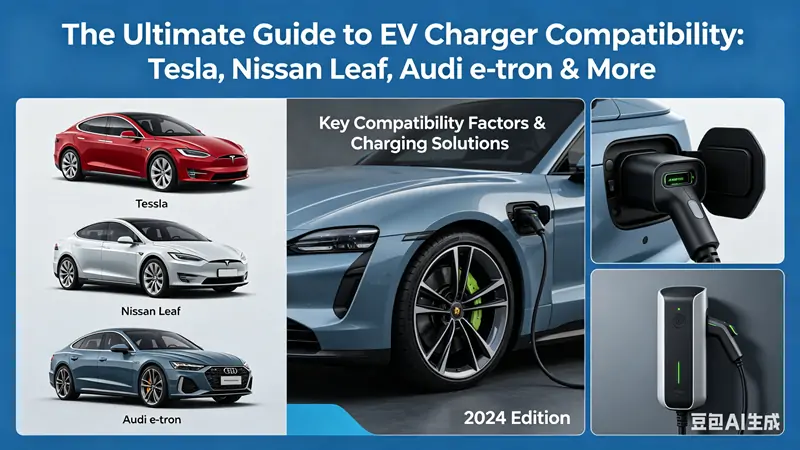
The connector type matters just as much as the power level. Here’s the short version of what each standard means for your charging experience:
J1772 — The Old Reliable
J1772 is the most widely supported connector in the US. Every non-Tesla EV sold in America before 2025 uses this standard. That includes the Nissan Leaf, Chevrolet Bolt, all Ford EVs, and most others.
If you drive anything except a Tesla, a J1772 charger is your baseline. Most Level 2 home chargers come with this connector built in.
NACS — Tesla’s Gift to the Industry
Tesla developed the North American Charging Standard connector. For years it only worked on Tesla vehicles. Then something interesting happened.
Ford adopted it. GM adopted it. Rivian and many others followed. NACS is now the most common connector on new US EVs. Many experts expect it to replace J1772 entirely within the next few years.
Older Tesla vehicles used a different port design. They included a J1772 adapter so you could charge at any public Level 2 station. Newer Teslas (2020+) use the NACS port directly.
CCS — The Fast Charging Standard
Combined Charging System uses the same pins as J1772 but adds two extra DC fast charge pins. This allows public DC fast chargers to deliver high power directly to your battery.
CCS is common on European EVs and on some American models from BMW, Hyundai, and Kia. At home, most Level 2 home chargers do not use CCS pins. The vast majority of home charging is AC, which works fine with J1772 or NACS.
CHAdeMO — The Fading Standard
CHAdeMO was popular on early EVs, especially the Nissan Leaf and some Mitsubishi models. It allowed DC fast charging at Level 3 speeds.
The problem? Almost no new EVs support CHAdeMO anymore. Even Nissan is moving away from it. If you own an older CHAdeMO-only vehicle, your charger options are shrinking fast. Look for chargers that include CHAdeMO or consider an adapter.
Which EV Charger for Tesla Model 3?
The Tesla Model 3 is one of the best-selling EVs in America. That means a lot of new owners asking the same question: Which EV charger for my car actually works with my car?
Here’s the short answer. The Model 3 maxes out at around 11kW AC charging on a Level 2 connection. That translates to roughly 44 miles of range per hour at full speed. Most Level 2 chargers deliver less power than your car can actually use, so matching 7.7kW to 11kW is the sweet spot for daily home charging.
Tesla Model 3 owners need either a NACS charger or a J1772 charger with the included Tesla adapter. The adapter comes with every Tesla sold in the US.
When shopping for the best EV charger for Tesla Model 3, most owners find a 7kW or 11kW Level 2 unit. You do not need a 22kW home charger unless you have three-phase electrical service, which is extremely rare in American homes. A 7kW unit adds about 30 miles per hour. That covers most people’s daily driving needs overnight.
Looking for a compatible home EV charger that works with your Model 3? FlagTools Level 2 chargers work with all Tesla vehicles using the included NACS adapter. Our 7kW and 11kW models are the top picks for Model 3 owners who want reliable daily charging without overpaying for power they cannot actually use.
Need help deciding between 7kW and 11kW? Check out our guide to EV charger power levels to see which output matches your daily driving distance and home electrical setup.
Which EV Charger for Nissan Leaf?
The Nissan Leaf holds a special place in EV history. It was one of the first mass-market electric cars and has been on the road since 2011. That longevity comes with some quirks.
The biggest compatibility issue for Nissan Leaf owners is the CHAdeMO port. Earlier Leaf models only had CHAdeMO for DC fast charging. Most Level 2 home chargers do not include CHAdeMO connectors. This is a real limitation when shopping for home charging equipment.
The good news for newer Leaf owners. 2024-2026 Nissan Leaf models now include CCS compatibility alongside CHAdeMO. That opens up many more home charger options. If you have a newer Leaf, look for a Level 2 charger with J1772 or CCS.
Leaf charging speed also matters. The onboard charger limits AC charging to 6.6kW on most models. That means even a 7kW home charger will max out the car’s intake. There is no benefit to buying a higher-output charger for an older Leaf.
An EV charger for Nissan Leaf at home should be at least 6.6kW to match the car’s capacity. A 7kW charger hits that ceiling without wasting money on excess power. Just make sure it supports your connector type.
Which EV Charger for Audi e-tron?
The Audi e-tron and its sibling the Audi Q8 e-tron use the CCS2 connector in the US market. This is the European standard that also gained traction here for higher-end EVs from German manufacturers.
Audi e-tron owners get an 11kW onboard AC charger. That is higher than most American EVs but still below what three-phase power can deliver. Most US homes run single-phase electrical service, so even with an 11kW onboard charger, you may be limited to 7-8kW in practice.
A compatible home EV charger for Audi e-tron needs to support CCS2. Most Level 2 home chargers sold in the US come with J1772, not CCS2. This is a key distinction when shopping. Some higher-end home chargers offer both.
If you want the fastest home charging for your e-tron, look for an EV charger for Audi e-tron that delivers at least 9.6kW. This gets you close to the 11kW ceiling without requiring three-phase installation.
For daily home charging, a 7kW Level 2 charger still adds significant range overnight. The e-tron’s large battery means most owners charge every other day rather than daily. A standard 7kW home setup handles this easily.
What About Other Popular EVs?
Here is a quick compatibility rundown for other EVs you might be researching.
Ford F-150 Lightning and Ford Mustang Mach-E use the NACS connector on newer models. A standard J1772 charger works with the included adapter. Charge speeds vary by model year, but most support 10-19kW at Level 2.
Chevrolet Bolt and Blazer EV use the NACS connector on 2025+ models. Older Bolts use J1772. A J1772 home charger covers most Bolts on the road today.
Hyundai Ioniq 5 and Kia EV6 use CCS1 in the US. Most Level 2 home chargers work with these vehicles. Both support around 10-11kW AC charging at home.
Rivian R1T and R1S use CCS1. Most Level 2 chargers work fine. The Rivian accepts around 11.5kW at Level 2.
Not sure which EV charger for your car? The good news is that most modern Level 2 chargers work across brands. Finding the best EV charger for Tesla Model 3 comes down to matching the output to your daily miles driven. The main variables are connector type and maximum power output.
How to Pick the Right Compatible Home EV Charger
You have read the car-by-car breakdown. Now how do you actually choose?
Here is the decision framework in four questions.
1. What connector does your car use? Check your owner’s manual or the charging port on your vehicle. J1772 and NACS are the most common in the US.
2. What is your car’s maximum AC charging speed? Buy a charger that matches or slightly exceeds this number. No benefit to paying for 22kW if your car only accepts 7kW. If you want to compare Level 1 vs Level 2 charging in detail, see our guide to home EV charging efficiency.
3. Do you need smart features? Some chargers offer WiFi, app control, and scheduling. If you want to charge during off-peak hours, these features matter. If you just want a plug-in-and-go solution, a basic model works fine.
4. Will you install it outdoors? Look for IP65-rated units for outdoor installation. Indoor garage installs have more flexibility. Our guide to outdoor-rated EV chargers covers what to look for in an exterior setup.
Common Compatibility Problems and How to Solve Them
Problem: My charger says Level 2 but it charges slowly.
This usually means the charger output exceeds your car’s onboard charger capacity. The car limits intake to protect its battery. Check your vehicle spec sheet for maximum AC charging speed.
Problem: I have a Tesla but my charger came with J1772.
Tesla includes a J1772 adapter with every vehicle. Use it. Any J1772 charger will work with your Tesla with this adapter. You can also buy a NACS-to-J1772 adapter for chargers that have NACS built in.
Problem: My older Nissan Leaf does not work with most home chargers.
You need CHAdeMO compatibility. Some Level 2 chargers include CHAdeMO ports. Others require an adapter. Adapters add cost and may limit charging speed. Check your specific model before buying.
The Bottom Line
Picking a compatible home EV charger does not have to be complicated. Most modern EVs sold in the US since 2011 use either J1772 or NACS connectors. Both work with the vast majority of Level 2 home chargers on the market.
If you drive a Tesla, use the included adapter. If you drive anything else, a standard J1772 Level 2 charger works for nearly every model.
The only real variables are maximum charge speed and connector type. Match these to your vehicle and you are set. For Tesla owners, the best EV charger for Tesla Model 3 is one that delivers 7-11kW with either a NACS connector or a J1772 unit plus adapter. Finding the best EV charger for Tesla Model 3 means matching the charger output to your car 7kW or 11kW Level 2 unit with the right connector. The best EV charger for Nissan Leaf is a 6.6kW+ unit with the right port. The best EV charger for Audi e-tron is a 9-11kW unit with CCS2. Still asking which EV charger for my car works best for your drive? Start with your daily miles and work backwards from there.
Ready to find the right charger for your EV?Browse the FlagTools Level 2 charger lineup to see models with J1772 and smart charging features. Every charger works with standard 240V outlets and installs in most home electrical panels without major upgrades.
Not sure which model fits your car? FlagTools offers technical support to help you pick the right charger based on your vehicle make, model, and daily driving needs. If you want a complete overview of Level 2 home charging before choosing a charger, see our The Complete Level 2 EV Charger Home Charging Guide.
Related: Winter Charging