Blog
7KW vs 11KW vs 22KW: How to Pick the Right Home EV Charger Power Level
Picking the wrong home EV charger power level is an expensive mistake. Most buyers overspend on a 22KW fast charger home setup when their daily drive only needs a fraction of that. This guide cuts through the noise.
What Do the Numbers Actually Mean?
KW stands for kilowatt. It’s a measure of how much power the charger pushes into your battery per hour.
A 7KW home charger delivers roughly 7 kilowatts. An 11KW delivers 11 kilowatts. A 22KW delivers 22 kilowatts.
More kilowatts means faster charging. Simple.
But faster isn’t always better. Your car, your electrical panel, and your daily driving habits all matter.
Breaking Down Each Power Level
7KW — The Daily Driver’s Choice
Most EVs can accept 7KW without any special electrical work. Plug it into a standard NEMA 14-50 outlet and you’re done.
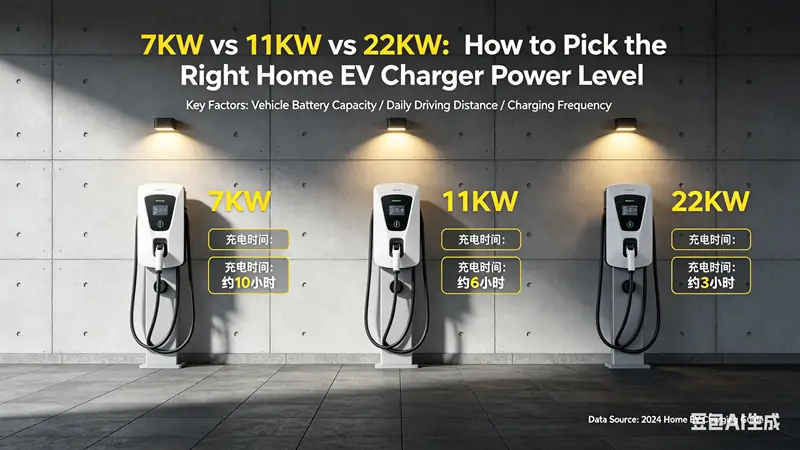
7KW adds about 25-30 miles of range per hour. For an average 30-40 mile commute, you wake up every morning with a full battery.
It works with any home electrical system that has a 50-amp circuit. If you already have an electric dryer outlet nearby, you’re halfway there.
The best part? Installation is cheap. Most homeowners spend $300-$800 on a 7KW setup.
11KW — The Middle Ground
11KW bumps you up to about 35-40 miles of range per hour. It charges noticeably faster than 7KW without the electrical heavy lifting of 22KW.
You’ll need a three-phase power connection though. Most US homes have single-phase power, which maxes out around 7.6KW on a 240V circuit.
If your home supports it, an 11KW EV charger home setup is a sweet spot. Faster daily charging without major electrical upgrades.
22KW — The Fast Charger Home Setup for Serious Drivers
22KW is the beast of home charging. It delivers 70-80 miles of range per hour.
At that rate, you can fully charge most EVs in 3-4 hours.
But here’s the catch. 22KW requires a three-phase connection AND significant electrical panel capacity. Most US homes simply can’t handle it without a $2,000-$5,000 panel upgrade.
If you’re running a commercial operation or have multiple high-capacity EVs, 22KW makes sense. For the average homeowner, it’s overkill.
How to Match Charger Power to Your Vehicle
Not all EVs charge at the same rate. Check your car’s onboard charger spec before buying anything.
A Tesla Model 3 supports up to 11KW on a home connection. A BMW iX3 maxes out around 11KW as well. A Porsche Taycan can actually handle 22KW if your home electrical system supports it.
If your car only accepts 7KW, spending extra on an 11KW or 22KW charger won’t charge you any faster. The car’s onboard charger is the bottleneck.
For more details on vehicle compatibility, see our guide to the best EV charger for Tesla Model 3.
Household Electrical Requirements
Here’s the real-world breakdown:
| Power Level | Circuit Required | Home Electrical Type |
|---|---|---|
| 7KW | 240V / 32A | Single-phase standard |
| 11KW | 240V / 16A three-phase | Three-phase required |
| 22KW | 240V / 32A three-phase | Three-phase + panel capacity |
Most American homes have single-phase power. That means 7KW is your realistic ceiling without electrical upgrades.
Before you buy a higher-power charger, check your panel capacity. If you have a 100-amp panel, you might need to upgrade before installing anything beyond 7KW.
For a full breakdown of electrical requirements, see our hardwired vs plug-in EV charger guide.
Which EV Charger Power for Home — The Quick Decision Guide
Go 7KW if:
- Your daily commute is under 50 miles
- You have a standard single-phase electrical panel
- You want the cheapest install possible
- Your EV’s onboard charger maxes out around 7KW
Go 11KW if:
- You have three-phase power or don’t mind the upgrade
- You drive over 60 miles daily
- You want noticeably faster charging without the 22KW price tag
Go 22KW if:
- You have a Porsche Taycan or similar high-capacity vehicle
- Your home already has three-phase power
- You run a small fleet and need fast turnaround
- You don’t mind spending $2,000+ on electrical work
The Cost Factor
Let’s talk money. Installation costs vary wildly based on power level.
7KW chargers typically cost $300-$800 to install. 11KW runs $500-$1,500 depending on your electrical setup. 22KW can hit $2,000-$7,000 when you factor in panel upgrades.
The energy cost per mile is identical across all three. Your utility bills the same rate per kilowatt-hour regardless of charger speed. The difference is only time.
Safety Features Matter at Every Power Level
Whatever power level you choose, don’t skip on safety features. Chargers with built-in surge protection, ground fault detection, and temperature monitoring protect your home and your EV battery.
FlagTools chargers include 8-layer circuit protection across the entire product line. If you want to understand what that means in practice, check our guide to EV charger safety circuit protection.
For outdoor installations, look for an IP65-rated EV charger outdoor to handle rain, dust, and temperature extremes.
Conclusion
For most US homeowners, 7KW is the right answer. It’s affordable, installs easily, and handles daily charging for 90% of drivers.
11KW makes sense if you have three-phase power or drive a high-capacity EV. 22KW is for special cases only.
Match the charger to your car, your electrical system, and your actual daily driving needs. Don’t pay for power you’ll never use.
Ready to find the right home EV charger for your setup?
👉 View FlagTools EV Charger Product Line — 7KW, 11KW, and 22KW models available If you want a complete overview of Level 2 home charging before choosing a charger, see our The Complete Level 2 EV Charger Home Charging Guide.
Related: Winter Charging
Related: Level 1 vs 2